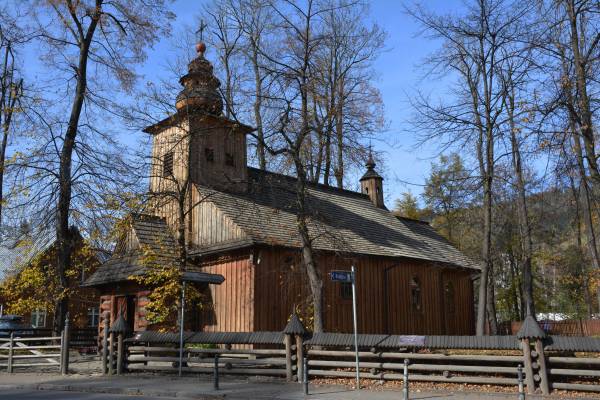
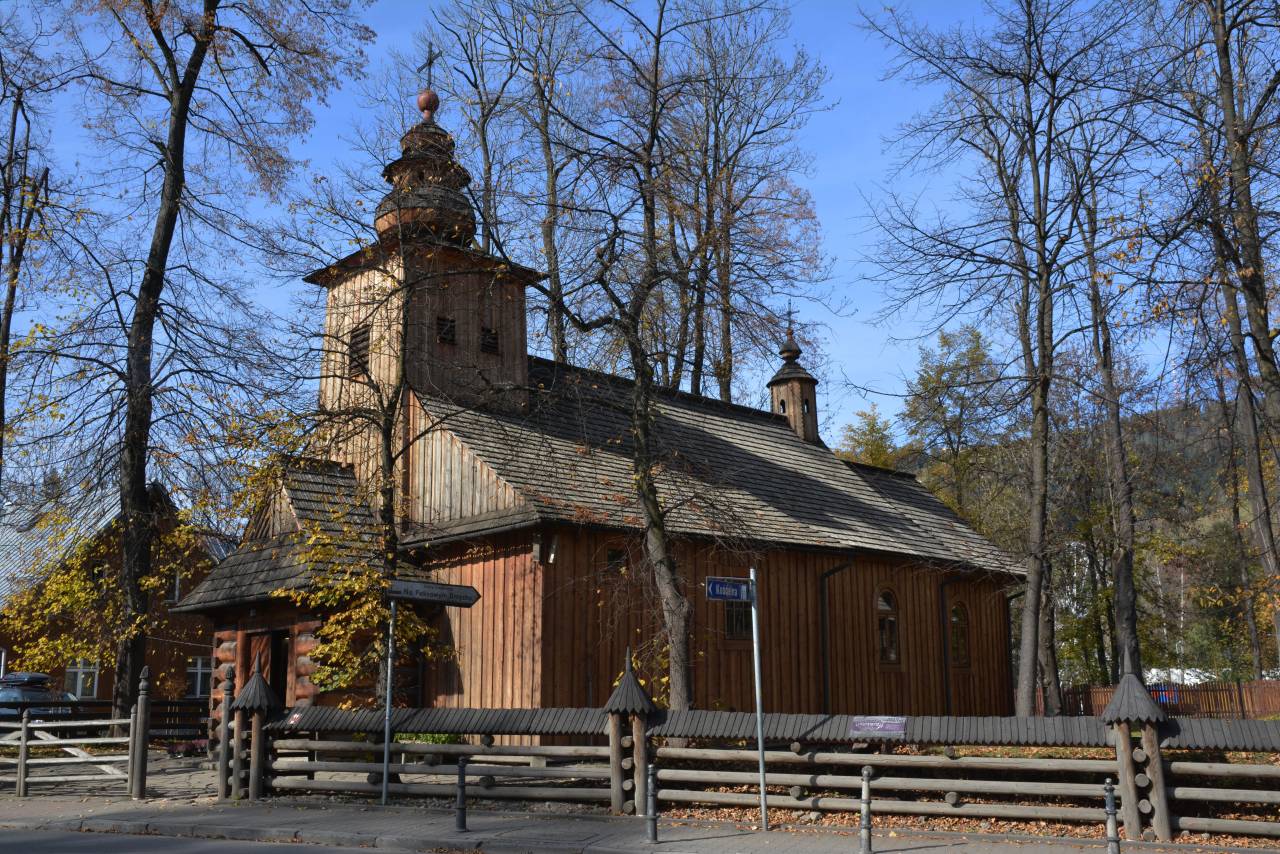
The Old Church The entire area on which the “old” church, the Gąsienica Chapel, and the cemetery are located is called Pęksów Brzyzek. The land was given by a rich landlord of Zakopane, Jan Pęksa, and the tall, flat, edge of the creek ( Quiet Water Creek) is called a “brzyzek” in the Highlander dialect, hence the name Pęksowy Brzyzek. In the first half of the 19th century, Zakopane was split into two different parishes with one being Chochołów, and the other, Poronin. Along with this inconvenience and the increase in tourists that come to visit the valley under Giewont, the then owners of the Zakopane region – Klementyna and Edward Homo lacsowie – began to work towards Zakopane having their own parish. The church was built in the years 1845-1847 by local carpenters and Sebastian Gąsienica-Sobczak, their leader. It is a simple, single-aisle church that is facing “11 o’clock”, as most traditional highlander homes face. At first, the church didn’t have a tower and the church bells were adjacent to the church itself. The first rector of Zakopane. Father Józef Stolarczyk, had the tower built in 1850, as well as, a presbytery. Contrary to widespread belief, Father Stolarczyk did not build the church from scratch, the first part of the church was already built. Inside the nave, the border between the old, and new, church is clearly visible. The simplicity of the church makes it resemble a barn; this is what Maria Steczkowska wrote in 1858, as did Frenchman Gustav Le Bon in 1879. The three altars were carved by an excellent highlander from Gliczarów, Wojciech Kułach-Wawrzyńcok. In the beginning, the church was named after St. Clement, whose image was at the main altar, now it is on the left side by the entrance to the sacristy. During World War II, the church patron was changed to Our Lady of Częstochowa, and a repli ca image of Our Lady replaced the image of St. Clement. A little known fact about the original pipe organ in the Old Church is that it no longer resides there, it is actually in St. Casmir’s church in neighbouring village of Kościelisko. In 2001 the Old Church underwent a largescale renova tion in which nearly the entire building was made fireproof.
A noteworthy stained-glass window with the Stations of the Cross painted by Zakopane-based artist, Ewelina Pęksa finds its place inside the nave. The nave also includes old carvings and a plaque dedica ted to the first rector of Zakopane. Another noteworthy feature is the raised trellis over the entrance designed by Antoni Kenara. Once the new church was built in 1899, the Old Church became a subsidiary parish to the Holiest Family Church. For over 160 years, highlanders, guests, and tourists pray here. Along with the Gąsienica Chapel, and the old cemetery, these are the most important monuments in Zakopane, and are considered sacred to the residents of this city.